

Design-First Vibe Coding: The Implementation Guide
This guide builds on the concepts introduced in Design-First Vibe Coding: Making AI Work at Enterprise Scale. While the first article explains why architecture—not prompts—is the foundation for scaling AI-assisted development, this guide focuses on implementation. It walks through the engineering practices that turned those principles into a repeatable delivery model.
Throughout this guide, one principle remains unchanged: AI output is always a draft. Responsibility for design, correctness, quality, and compliance remains with the engineering team
Initializing the Architecture Repository
Every implementation begins with the architecture repository.
Rather than serving as a collection of diagrams, it becomes the single source of truth for architectural intent, capturing the decisions, constraints, and standards that guide both engineers and AI agents throughout the software lifecycle.
At a minimum, the repository should capture:
- Project constraints – regulatory, operational, organizational, and technical boundaries.
- Architecture drivers – the forces shaping the solution, such as scalability, latency, security, maintainability, and cost.
- Architecture style – structural decisions including service boundaries, integration patterns, layering, and data ownership.
- Quality goals – non-functional requirements such as resilience, observability, performance, security, and testability.
- Architecture decisions – documented design decisions together with their rationale and trade-offs.
Managing these artifacts in version control makes architectural knowledge explicit, traceable, and reusable. Instead of relying on tribal knowledge or scattered documentation, every implementation starts from the same approved architectural foundation.
Making architecture explicit also enables something equally valuable: architectural reasoning.
Because architecture drivers, constraints, and quality goals are clearly defined, AI can do more than generate code. It can evaluate architectural decisions against stated objectives, identify conflicting requirements, and highlight trade-offs before implementation begins.
Architecture is no longer passive documentation. It becomes an active engineering asset that guides implementation, supports design reviews, and forms the foundation of the entire delivery process.
The Design-First Lifecycle
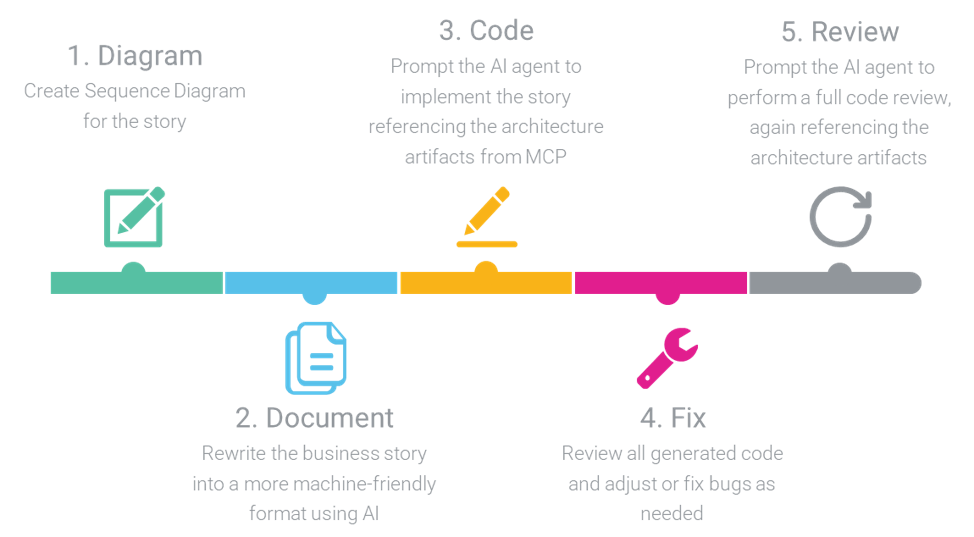
Once architecture is established and made available through the Architecture MCP Server, every implementation follows the same repeatable workflow.
This ensures AI works from approved architectural context rather than inferring design from existing code.
1. Design
Every story begins with design.
Before implementation starts, architects and developers define the interaction flow using sequence diagrams, typically written in PlantUML and stored alongside the service's low-level design documentation.
These diagrams capture architectural intent, service interactions, and responsibilities without prescribing implementation details.
2. Document
Business requirements are then refined into structured, machine-friendly user stories using AI in Ask Mode.
The objective isn't to make the story longer or more detailed. It's to eliminate ambiguity, clarify assumptions, and produce a specification that both engineers and AI agents can interpret consistently.
3. Code
Implementation begins by retrieving the relevant architectural context from the Architecture MCP Server.
Rather than inferring architecture from existing code, AI agents work directly from approved design artifacts, including:
- High-level and low-level architecture documentation
- Service-specific design documents
- Business rules
- Coding standards
- Architectural constraints
You get a code that aligns with the intended architecture from the outset instead of relying solely on prompt engineering or patterns inferred from the codebase.
4. Validate
AI-generated code is never accepted without review. Developers validate the implementation, make any required adjustments, and ensure the generated solution satisfies functional, architectural, and quality requirements.
AI accelerates implementation; engineering judgment remains essential.
5. Review
The final stage is an architecture-aware AI review.
Unlike traditional code reviews that focus primarily on syntax or best practices, the AI reviewer evaluates the implementation against the approved architecture by referencing:
- Architecture diagrams
- Sequence diagrams
- Design documentation
- Coding standards
- Platform guidelines
This leads to a structured review that traces every observation back to a specific architectural artifact, making reviews more consistent, transparent, and easier to validate.
Why Architecture, Not Prompts, Is the Right Abstraction
A common response to inconsistent AI-generated code is to invest more effort in prompt engineering.
We tried that.
What we learned is that prompts are the wrong abstraction for governing AI behavior at enterprise scale.
Prompts are:
- Temporary and difficult to version.
- Closely tied to individual developers.
- Difficult to govern, review, and audit consistently.
Architecture is different.
It is:
- Explicit and intentional.
- Version-controlled and reviewable.
- Shared across teams and projects.
- Governed as part of the engineering process.
By making architecture accessible through the Architecture MCP Server, we shifted the focus from how we prompt AI to what we define architecturally.
Instead of improvising, AI agents implement software within clearly defined architectural boundaries.
What We Learned
Applying this model across enterprise projects has produced several measurable improvements.
We observed more consistent implementations across teams, architectural issues being identified during development rather than after release, faster onboarding through centralized architectural knowledge, and greater confidence in AI-assisted delivery for regulated environments.
Along the way, we leanred that
- Over-documentation is just as harmful as under-documentation.
- Architecture should be intentional and actionable—not exhaustive.
- AI increases the importance of engineering reviews; it does not replace them.
Design-first vibe coding succeeds because engineering discipline increases—not because it disappears.
The Bigger Shift
Design-first vibe coding isn't about restricting AI.
It's about giving AI the architectural context it needs to become a reliable part of enterprise software delivery.
By treating architecture as a machine-consumable engineering asset rather than static documentation, we preserve the speed and productivity of AI-assisted development while maintaining the consistency, governance, and quality that enterprise systems require.
Most importantly, this approach reinforces a principle that remains unchanged regardless of how capable AI becomes.
AI accelerates software delivery. Architecture guides it. Engineers remain accountable for it.