

How to Leverage Integration: the Transition from SOA to ESB to APIs
Introduction
When it comes to making sure your digital business runs smoothly and efficiently, nothing is more important than integration. But what do we mean when we talk about integration – and more important, how do you make it work?
Integration can be a daunting concept – but it doesn’t have to be. With the right tools and knowledge, you can easily leverage integration to make your digital business run with greater efficiency and success. In this article, we’ll take a step-by-step look at the three main types of integration: service-oriented architecture (SOA), enterprise service bus (ESB), and application programming interfaces (APIs). Along the way, we’ll discuss the benefits of each type of technology and how you can use them to help bridge the gap between your IT systems.
History of Integration
Integration is nothing new—from the banking industry to telecommunications, organizations have been utilizing integration strategies for years. At its simplest, integration is all about connecting systems, applications and platforms to help organizations access valuable data.
Let’s take a look at the history of integration to get a better understanding of how we got to where we are now. This begins with Service Oriented Architecture (SOA) which made complex systems accessible across secure networks.
Next came Enterprise Service Bus (ESB) which allowed reliable communication between applications and services with guaranteed delivery, scale and governance standards. ESB worked quite effectively for many businesses since it introduced real-time connectivity between multiple systems used by an organization.
The third major development in integration technology has been the advancement of open Application Programming Interfaces (APIs). This technology helps unify systems by allowing them to share data over an open platform without the need for proprietary hardware or software layers.
SOA
However, SOA requires complex network configurations and web service protocols like SOAP and XML which can be hard to manage. This is where an Enterprise Service Bus (ESB) comes into play. It acts as a middleware to manage communications between both applications and services.
ESB allows you to define endpoints like web services—which makes configuring new services much easier—and this facilitates faster system integration while giving you more control over your data flow. ESB also helps in managing security and performance within the system, allowing for easier scaling and better management of resources.
Nowadays APIs are becoming increasingly popular for business integration due to their relative simplicity, scalability, and low cost of implementation. APIs don’t require complex network configurations since they only have a single point of contact with your application or service, which makes it easier to develop apps without too much overhead. APIs also help in providing integration as a service which simplifies the process for developers by providing them with an easy to use and secure way to access your systems data.
ESB
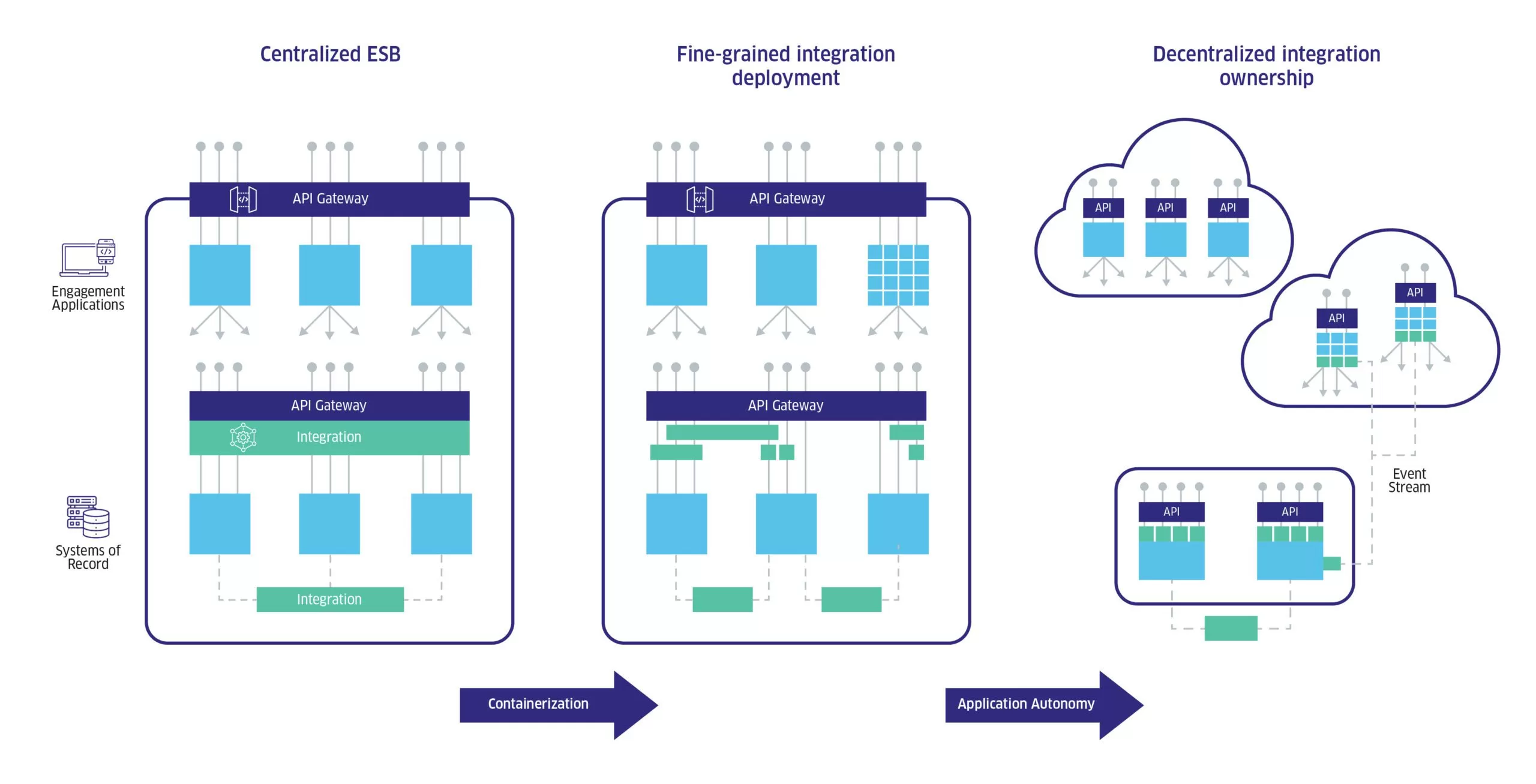
The second step in your integration journey is transitioning from SOA to ESB. ESBs, or Enterprise Service Busses, are middleware tools that provide improved communication and integration between disparate applications. They’re powerful because they allow for a great deal of flexibility in terms of the services it can provide and the applications it can integrate.
Here’s a few examples of what an ESB can do for you:
- Allow for a centralized configuration of different service endpoints and simplify data processing logic
- Offer multiple transport protocols such as HTTPS, FTP, MQTT, etc., to connect applications with heterogeneous systems
- Enable fault tolerance in distributed environments with load balancing and error handling capabilities
- Support business process orchestration to integrate different systems in the dynamic business environment
- Provide extensibility to adapt easily to changing requirements
APIs
Migrating from service-oriented architecture (SOA) to enterprise service bus (ESB) to application programming interfaces (APIs) is an integration journey that can be full of potential. By leveraging APIs, you unlock a whole new world of possibilities: more efficient data exchange between applications, increased flexibility and scalability, and a faster time-to-market for your products and services.
So why should you move away from SOA and ESB to APIs? Here are three key reasons:
- You get faster data exchange speeds: APIs are lightweight, so communicating between two systems doesn’t take nearly as long as it would with SOA and ESB.
- You gain more flexibility: API calls can easily be tailored to specific requirements, so your technology stack supports any kind of business logic you might need in the future.
- Increased scalability: When you use APIs, you can scale up or down depending on demand quickly and easily, due to the API gateway’s ability to manage multiple requests simultaneously.
By leveraging APIs, you benefit from greater speed, efficiency and scalability than ever before—all while maintaining the highest level of security for your business data and applications. Now that’s something worth migrating towards!
Making the Transition from SOA to ESB and APIs: Key Considerations
When making the transition from SOA to ESB and APIs, there are key considerations to keep in mind. First and foremost, it is essential to evaluate the current requirements of your systems and architecture. Based on those requirements, you can begin to plan the process of transitioning from SOA to ESB and APIs while keeping the following points in mind:
Streamlining processes
Integration should be viewed as an opportunity to streamline your organization’s processes. By optimizing how workflows are performed, integrating systems can help reduce costs associated with manual labor and automation. Utilizing integrations that provide a single interface to multiple applications can increase efficiency when accessing or exchanging data between disparate systems.
Improved security
Integrations often require users to access data from various applications in one common interface. In order to protect sensitive data from unauthorized access, it is important to ensure that the integration platform provides adequate safeguards for authentication and authorization. Additionally, proper encryption of data should be used for any sensitive information that is being transmitted between different systems.
Flexibility
It is important that your integration platform is flexible enough for future changes or adjustments in requirements being driven by customers or other stakeholders. API-based integrations offer flexibility with dynamically updatable endpoints which can be easily reconfigured if necessary without requiring significant additional development time or cost. Additionally, utilizing microservice architectures allows organizations to build services quickly while scaling them independently when needed.
By taking into consideration these key factors when transitioning from SOA to ESB and API-based solutions, organizations will be poised for success as they continue towards modernizing their integrations strategies.

How Do APIs Fit Into Modern Integration Strategies?
As companies have adopted more sophisticated IT infrastructures and digital processes, they have increasingly turned to APIs as their go-to integration solution. So what’s the big deal with APIs that makes them such a popular choice?
Let’s talk about three ways APIs make modern integration strategies better.
Cost savings
Using APIs for integration can save your company money. They streamline the process and reduce data errors — both of which help bring down operational costs. Plus, since you don’t need external programmers or consultants to build or maintain the APIs, you can avoid additional expenses as well.
Cloud scalability
APIs are cloud-friendly and scaleable — two essential characteristics for today’s businesses. Since they make it easier to add new functionality without taking down their entire system, they make it easier to plan out new projects and innovation without worrying that their architecture won’t be able to handle it.
Speed
APIs are good at responding quickly to requests — indeed, that’s one of the primary reasons for using them. This speed is great for customer experience but also helps developers save time when debugging by offering instantaneous feedback on errors or other issues with a system.
That’s how APIs fit into modern integration strategies — effectively, efficiently, and with a lot of cost savings along the way!

What’s Next for Agile Integration?
Agile integration technology has come a long way in the past few years and is here to stay. But what does the future hold? Here are some top statistics about agile technology’s future that you need to know:
- Increasing Adoption Rates: According to a recent survey of C-level executives, 63% of businesses are planning on adopting agile integration solutions over the next two years.
- Growth of Hybrid Integrations: Hybrid integrations – a combination of on-premise and cloud-based integrations – are expected to grow exponentially over the next couple of years, with 86% of businesses predicting they will be using hybrid integrations within three years.
- Shift Toward Automation: 68% of organizations believe that automation will become even more important in the coming years, with automation saving time, money and resources while speeding up time-to-market for new products and services.
As these statistics indicate, agile integration is set to revolutionize how businesses work over the coming years, so it’s essential you stay up-to-date with the latest news and trends in this field.
Conclusion
In summary, regardless of whether you are transitioning from SOA to ESB to APIs, or have already found success with such integration, one thing is certain: the architecture of today’s integration platforms is constantly evolving. It is important to stay informed of the latest technologies and industry trends, and to identify the best integration architecture for your business needs.
By leveraging the optimal integration architecture, you can maximize your reach and ROI and attain the desired business objectives. Make sure to take the time to properly evaluate your needs and review the best options available to you. With the right integration strategy, your business can enjoy the benefits of a streamlined system for your organization’s success.