Microservices Adoption - Key for Banks' Survival

BLOG
X
min read

With the strategic objective of banks being to deliver a unique customer experience, digital transformation has become a key topic in the financial industry over the last few years. Also, Microservices Adoption has been recently the buzzword among IT leadership in financial institutions.

FinTechs have significantly raised the benchmark for customer experience which has made it more difficult for traditional banks to compete. For instance, Monzo, an online bank, now has more than 5 million customers, a level reached in less than six years. There are numerous rising Fintechs involved in digital banking (N26, Monzo, Starling, etc.), digital payments and mobile wallets among many other areas.

The key success factor for these FinTechs is “Time-to-Market”. They are superfast, innovative and exceed customer expectations. When it comes to “Time-to-Market”, traditional banks struggle to deliver at high velocity due to the challenges within their IT infrastructure and legacy systems.

In our eBook, “Time-to-Market Driven Disruption”, we discussed how microservices architecture, a software engineering paradigm shift away from monolithic and traditional systems, plays an important role in increasing business agility. Combined with Agile and DevOps, microservices help teams to deliver quick daily/weekly releases rather than this taking months.

use cases for microservices in banking

Featured E-Book

Leading The Digital Banking Era with Microservices

5 Use Cases for Microservices Architecture in Banking

This eBook, brought to you by Sumerge and Red Hat team,  brings unique approaches for financial institutions to lead the digital banking era with microservices.

Get the eBook

5 Key Areas for Microservices Adoption in Banking:

For the banking industry, there are five key areas that, in our opinion, microservices adoption would have the highest impact on:

1. Digital Banking
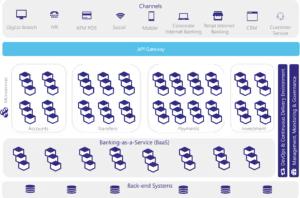
Traditional digital banking platforms are not designed for today’s competitive world and fail to meet customer expectations. Banks are now in a digital race!

Every bank is focusing on offering “All” its services as digital. The number of new requirements and the innovation needed in internet and digital banking is tremendous in a way that all existing internet off-the-shelf banking packages can’t cope with. Those legacy internet banking platforms were not designed to handle this amount of change and the fast time-to-market demands.

2. Time-to-Market

How can banks deliver new services and features in daily/weekly releases instead of months? Microservices architecture enables teams to apply DevOps practices to speed up their development process since each feature is built, tested and deployed independently thus enabling teams to ship new features quickly and independently of each other.

Also, due to the nature of the architecture, multiple teams can work together in parallel, thereby also increasing the frequency of releases per month. The time-to-market in a microservices environment can be improved by up to 10 times or even more. Basically, you are transforming your culture to a “Release on Demand” approach, a customer centric culture that allows your financial institution to deliver releases in hours or days rather than in months and years.

3. Distributed Integration Platform (Agile Integration)
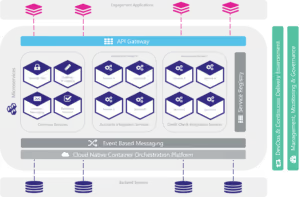
Agile Integration Platform - System Architecture - Banking

Several banks have adopted ESB technologies to integrate different banking systems with each other. And after years of adoption, they found that they had created an extremely huge and complex layer cross cutting the enterprise. This ESB became very sensitive to touch, scale and maintain. It became a single point of failure in the enterprise. In addition, it got transformed from an integration platform to a platform containing a lot of business logic. In other words, an ESB that is built on a centralized integration approach has hindered the journey to digital transformation for most banks.

Distributed Integration Platforms (Agile integration) transforms the traditional ESB methodology to a decentralized approach thereby enabling business agility and the rapid development of API and integration services. With microservices architecture, each integration service is built, tested, deployed and managed independently. Similar to the nature of microservices, each integration service will be auto-scaled based on the needs of the workload.

In addition to building integration services over microservices, an event-based architecture is used thus ensuring run-time decoupling. Instead of services directly calling one another, a service will publish an event in a queue which will be listened to and acted upon by a subscriber.

4. Rethinking your Legacy Systems

With initiatives such as platform banking, distributed integration, open banking and many others, banks have been exploring solutions that will modernize their legacy systems. Existing legacy banking applications were not built to support the changing needs of the market and, more importantly, the cost of maintaining these systems has become very high. Again, time-to-market is a key factor for banks to deliver fast breakthrough features.  Legacy systems slow down the deployment of new services; what could be shipped in 1 or 2 days, takes 2 to 3 months.

With the evolution of technology and application management, microservices application modernization has come to transform the enterprise architecture as well as the deployment topology incorporating DevOps to deliver new capabilities at high velocity and of better quality. Based on the bank’s business drivers, legacy modernization could be more a matter of containerization, repackaging and refactoring or a combination of both.

It’s important to note that legacy modernization is a journey. It starts with analyzing existing applications and their risks, followed by the creation of a roadmap for the pattern of modernization. With an Agile and DevOps culture, banks can monitor progress as soon as the first containerized application is deployed. The plan continues to roll-out across applications that were defined during the discovery phase.

5. Moving to Cloud Native Platforms
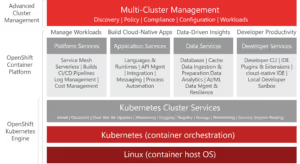
red hat openShift container platform

Moving to container orchestration platforms like Kubernetes and Red Hat OpenShift overcomes infrastructure challenges and achieves faster time-to-market. These platforms help enterprises to build applications faster and deliver and scale across hybrid cloud environments using microservices and containers. These platforms have self-service capabilities that allow you to provision new environments easily with auto-scaling and auto-recovery capabilities to guarantee uptime.

Let Sumerge help you with your Microservices Adoption

Sumerge helps institutions with their microservices adoption and digital transformation journey. Check-out our services and Set up a workshop with one of our consultants to gain a more in-depth understanding of how we can use microservices, DevOps and RedHat OpenShift to revolutionize your bank’s digital transformation.


Modernizing Legacy Apps​

Maecenas mollis sagittis ante, eleifend ultricies sapien. Nam ultricies risus et augue auctor vulputate gravida eget sem. Quisque mollis gravida magna, eu semper eros pharetra in. Sed et elit sit amet odio rutrum consectetur vel vel ante. Praesent vitae elementum lacus. Vivamus efficitur nunc tortor, cursus lobortis purus placerat ut. Maecenas ut aliquet ante, vel finibus lorem. Nulla facilisi. Donec maximus elementum pulvinar.

test heading

h1 text

h3

Impact

Sample article featured image
Pellentesque posuere sem in ipsum venenatis, at bibendum lorem aliquam. Nullam condimentum tempus orci nec commodo. Maecenas malesuada elementum metus, non aliquam est elementum sed. Integer ac finibus ligula, id venenatis lectus. Mauris non eleifend enim. Pellentesque eu congue justo. In ornare dapibus nisi, sit amet feugiat neque. Vivamus mollis, lectus quis gravida viverra, risus ligula congue felis, ut laoreet sem nisi in tortor. Sed vel ligula nulla.
“Quisque mollis purus nec pulvinar rutrum. Duis faucibus sed orci vel pellentesque. Interdum et malesuada fames ac ante ipsum primis in faucibus. Donec non volutpat eros, nec placerat mi. Praesent porta felis ut urna sagittis, sit amet placerat nisl porttitor.”

Nunc tempor molestie velit id dictum. Aenean ac venenatis ipsum, sit amet sodales tortor. Pellentesque habitant morbi tristique senectus et netus et malesuada fames ac turpis egestas. Pellentesque posuere sem in ipsum venenatis, at bibendum lorem aliquam.

Nullam condimentum tempus orci nec commodo. Maecenas malesuada elementum metus, non aliquam est elementum sed. Integer ac finibus ligula, id venenatis lectus. Mauris non eleifend enim. Pellentesque eu congue justo. In ornare dapibus nisi, sit amet feugiat neque. Vivamus mollis, lectus quis gravida viverra, risus ligula congue felis, ut laoreet sem nisi in tortor. Sed vel ligula nulla.

data-acc-source-start

Ensure that Modernizing your Legacy Application is the Right Decision

Our expert consultants work closely with you to understand you organization's business drivers, then conduct an in-depth business goals and that every dollar invested is directed towards the right solution

Depend on a Tailored, Phased Application Modernization Strategy

Our expert consultants work closely with you to understand you organization's business drivers, then conduct an in-depth business goals and that every dollar invested is directed towards the right solution

Streamline the Transition from Old to New

Our expert consultants work closely with you to understand you organization's business drivers, then conduct an in-depth business goals and that every dollar invested is directed towards the right solution

data-acc-source-end

Lorem ipsum dolor sit amet, consectetur adipiscing elit. Curabitur elementum, elit a pellentesque placerat, nisl quam blandit orci, at maximus eros nunc nec lacus. Nullam euismod consequat libero, eget suscipit ligula lacinia nec. Nunc finibus dapibus quam, eu convallis magna. Nulla finibus ut risus in sodales. Cras tristique nisi non mattis volutpat. Nullam venenatis varius nisl, dictum ornare lorem dictum rhoncus. Nulla sem nunc, lobortis et massa sed, ultrices convallis justo. Quisque laoreet nibh sit amet arcu rhoncus accumsan. Proin at elementum lacus, at maximus mi. Curabitur vulputate urna mollis lacinia auctor. Donec venenatis finibus magna id tempor. Duis at mattis odio. Aenean eu tempus justo. Donec est arcu, vulputate quis risus et, pharetra imperdiet velit.

Vivamus ut dignissim quam.

No items found.
Article carousel image 1
Article carousel image 2
Article carousel image 3
Author
Adham Jan
Posted on
27 May 2021
We’re your partner in addressing

real human needs.

Align IT Initiatives with Strategic Business Goals
Plus sign iconMinus sign icon
10X
Increase in transactions
per second

Heading 1

Heading 2

Heading 3

Heading 4

Heading 5
Heading 6

Lorem ipsum dolor sit amet, consectetur adipiscing elit, sed do eiusmod tempor incididunt ut labore et dolore magna aliqua. Ut enim ad minim veniam, quis nostrud exercitation ullamco laboris nisi ut aliquip ex ea commodo consequat. Duis aute irure dolor in reprehenderit in voluptate velit esse cillum dolore eu fugiat nulla pariatur.

Block quote

Ordered list

  1. Item 1
  2. Item 2
  3. Item 3

Unordered list

  • Item A
  • Item B
  • Item C

Text link

Bold text

Emphasis

Superscript

Subscript

Modernizing Legacy Apps​

Maecenas mollis sagittis ante, eleifend ultricies sapien. Nam ultricies risus et augue auctor vulputate gravida eget sem. Quisque mollis gravida magna, eu semper eros pharetra in. Sed et elit sit amet odio rutrum consectetur vel vel ante. Praesent vitae elementum lacus. Vivamus efficitur nunc tortor, cursus lobortis purus placerat ut. Maecenas ut aliquet ante, vel finibus lorem. Nulla facilisi. Donec maximus elementum pulvinar.

Impact

Sample article featured image
Pellentesque posuere sem in ipsum venenatis, at bibendum lorem aliquam. Nullam condimentum tempus orci nec commodo. Maecenas malesuada elementum metus, non aliquam est elementum sed. Integer ac finibus ligula, id venenatis lectus. Mauris non eleifend enim. Pellentesque eu congue justo. In ornare dapibus nisi, sit amet feugiat neque. Vivamus mollis, lectus quis gravida viverra, risus ligula congue felis, ut laoreet sem nisi in tortor. Sed vel ligula nulla.
“Quisque mollis purus nec pulvinar rutrum. Duis faucibus sed orci vel pellentesque. Interdum et malesuada fames ac ante ipsum primis in faucibus. Donec non volutpat eros, nec placerat mi. Praesent porta felis ut urna sagittis, sit amet placerat nisl porttitor.”

Nunc tempor molestie velit id dictum. Aenean ac venenatis ipsum, sit amet sodales tortor. Pellentesque habitant morbi tristique senectus et netus et malesuada fames ac turpis egestas. Pellentesque posuere sem in ipsum venenatis, at bibendum lorem aliquam.

Nullam condimentum tempus orci nec commodo. Maecenas malesuada elementum metus, non aliquam est elementum sed. Integer ac finibus ligula, id venenatis lectus. Mauris non eleifend enim. Pellentesque eu congue justo. In ornare dapibus nisi, sit amet feugiat neque. Vivamus mollis, lectus quis gravida viverra, risus ligula congue felis, ut laoreet sem nisi in tortor. Sed vel ligula nulla.

data-acc-source-start

Ensure that Modernizing your Legacy Application is the Right Decision

Our expert consultants work closely with you to understand you organization's business drivers, then conduct an in-depth business goals and that every dollar invested is directed towards the right solution

Depend on a Tailored, Phased Application Modernization Strategy

Our expert consultants work closely with you to understand you organization's business drivers, then conduct an in-depth business goals and that every dollar invested is directed towards the right solution

Streamline the Transition from Old to New

Our expert consultants work closely with you to understand you organization's business drivers, then conduct an in-depth business goals and that every dollar invested is directed towards the right solution

data-acc-source-end

Lorem ipsum dolor sit amet, consectetur adipiscing elit. Curabitur elementum, elit a pellentesque placerat, nisl quam blandit orci, at maximus eros nunc nec lacus. Nullam euismod consequat libero, eget suscipit ligula lacinia nec. Nunc finibus dapibus quam, eu convallis magna. Nulla finibus ut risus in sodales. Cras tristique nisi non mattis volutpat. Nullam venenatis varius nisl, dictum ornare lorem dictum rhoncus. Nulla sem nunc, lobortis et massa sed, ultrices convallis justo. Quisque laoreet nibh sit amet arcu rhoncus accumsan. Proin at elementum lacus, at maximus mi. Curabitur vulputate urna mollis lacinia auctor. Donec venenatis finibus magna id tempor. Duis at mattis odio. Aenean eu tempus justo. Donec est arcu, vulputate quis risus et, pharetra imperdiet velit.

Vivamus ut dignissim quam.

No items found.
Article carousel image 1
Article carousel image 2
Article carousel image 3
Author
This is some text inside of a div block.
Posted on
This is some text inside of a div block.
Topics