

Road to System Modernization
In today's fast-paced and ever-evolving digital landscape, businesses face the pressing challenge of keeping their systems relevant, efficient, and adaptable. As we all know, nothing remains the same over the years, and this holds true not only for individuals but also for software and systems. The business you are running today is not the same as it was when you first started, and it will continue to evolve even further in the years to come. Therefore, it is vital to ensure that your systems can keep up with the rapid pace of change.
As the focus has shifted towards technologies that are easily adaptable and capable of seamlessly integrating with evolving business needs and customer expectations, businesses across all industries are exploring ways to leverage and embrace the emerging trends and technologies to modernize their inflexible legacy systems.
System modernization is a crucial strategy that involves the transformation of existing legacy systems into more advanced, scalable, and flexible architectures that can meet the demands of the modern era. By adopting modern architectural designs, businesses can unlock a wealth of benefits, including enhanced performance, improved security, increased agility, and the ability to integrate seamlessly with emerging technologies.
In this blog, we will delve into the realm of system modernization and its importance. We will explore the different approaches and the key technologies that organizations should consider, to guide them in their journey to revamp their systems and embrace the future heads-on.
What is system modernization and why is it needed?
To fully understand what system modernization is, let us first define what a legacy system is. A legacy system refers to a system with outdated infrastructure, software, technology, or process. These systems are difficult and expensive to maintain and upgrade due to lack of technology support and challenges in integrating with other systems due to hardware or software platform incompatibility.
Legacy systems are tightly coupled, inflexible systems that hinder progress and innovation and are no longer agile to emerging customer needs. They are considered a financial burden for organizations due to the increasingly challenging and costly task of finding skilled professionals who can effectively maintain and troubleshoot legacy systems. Additionally, organizations may need to invest in training or hire expensive consultants to handle maintenance, support, and bug fixing. Furthermore, organizations may require custom integration solutions or middleware to bridge the gap between legacy systems and newer technologies, resulting in increased expenses. To mitigate these financial burdens, organizations need to embrace an agile mindset and demonstrate a commitment to innovation by adopting adaptable systems capable of integrating with evolving business needs and customer expectations.
That is why system modernization is a crucial strategy adopted by many companies today. System modernization is the process of transforming legacy systems into more advanced, adaptable, scalable, and flexible architectures. It is a strategy to update and optimize legacy systems with modern platform infrastructure, architecture, and/or features to achieve significant leaps in performance, agility, and innovation. Organizations seek to modernize their systems to achieve operational efficiency for internal and external customers, reduce cost, and attain IT agility by adjusting their environment to react faster to changes, leveraging data across departments, integrating systems to optimize processes, and seizing new opportunities for innovation.
The journey of system modernization depends on the state of the legacy system, the problem facing the organization, and the business goals. There are many approaches to migrate, update, and optimize a legacy system towards a more modern architecture.
System Modernization Approaches and Technologies
While there are various approaches to system modernization, IT experts consider six approaches to be the primary ones, as they provide a spectrum of options.
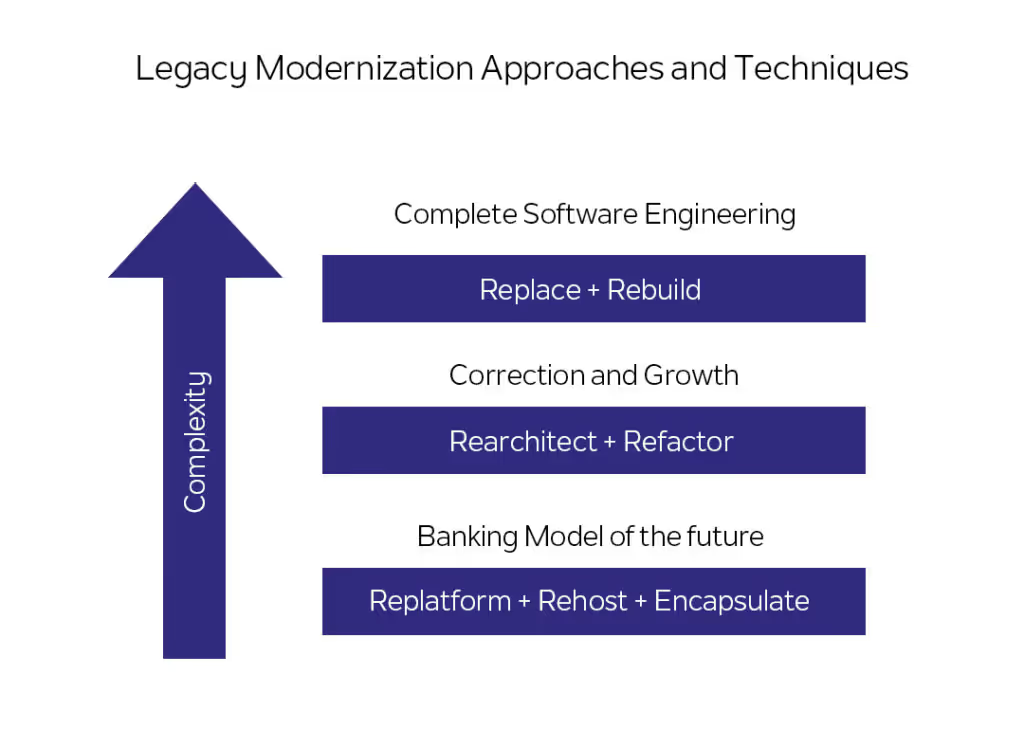
• Encapsulate: This approach involves wrapping the existing system with a new interface or layer allowing the system to interact with modern technologies such as web services or APIs while preserving the core functionality.
• Rehost & Replatform: In this approach, the existing system is migrated from one platform to another. This can involve redeploying the existing software from an on-premises data center to a new virtual environment or shifting from one programming language or database to another. The primary goal is to leverage the benefits of the target platform, such as scalability, cost-effectiveness, or improved development productivity.
• Refactor: The focus of this approach is to improve the internal structure of the system without changing its external behavior. It involves making code-level changes to enhance readability, maintainability, and extensibility while reducing technical debt. Refactoring can also involve adopting new design patterns or best practices.
• Rearchitect: This approach involves rethinking and redesigning the architecture, components, and functionality of the existing system to improve system performance, scalability, and maintainability while retaining some of the original system's core features.
• Rebuild: This approach entails redesigning or rewriting the system while ensuring that it fulfills the same scope, specifications, and functionality.
• Replace: In this approach, the existing system is eliminated entirely and replaced with a new one that considers new requirements and/or enhanced functionality from the original system. This is necessary when the existing system is outdated, inefficient, or unable to meet evolving business requirements.
The most suitable approach depends on factors such as the current state of the legacy system, business requirements, budget, and available resources.
Organizations should typically take advantage of several key technologies when considering system modernization. These technologies include cloud computing, Kubernetes, microservices, automation, DevOps, and APIs.
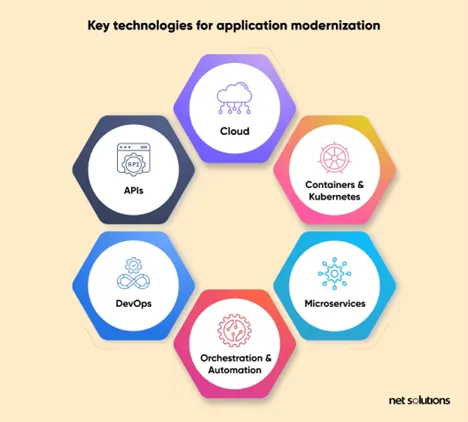
Cloud computing is a crucial aspect of application modernization, offering advantages such as scalability, reliability, and cost savings. Organizations can leverage various cloud options, including public, private, hybrid, and multi-cloud, to replatform or rehost applications and harness the benefits of the cloud environment.
Kubernetes, an open-source container orchestration platform, enables organizations to manage and deploy applications across clusters of machines. It provides scalability, fault tolerance, and automated deployment, making it a valuable technology for modernizing systems. Microservices architecture involves breaking down monolithic applications into smaller, loosely coupled services. This enables organizations to develop and deploy applications more independently, improve scalability, and enhance agility.
Automation plays a crucial role in system modernization by automating repetitive tasks, reducing manual effort, and increasing efficiency. Technologies like process automation and workflow automation can streamline processes and improve productivity. DevOps practices focus on collaboration, communication, and automation between development and operations teams. By adopting DevOps principles, organizations can accelerate the delivery of software, improve quality, and enhance system stability.
APIs allow systems to communicate and interact with each other. They enable organizations to integrate different systems, share data, and build new applications on top of existing systems. APIs are essential in creating a modular, extensible architecture.
Conclusion
System modernization is an essential strategy for organizations to keep their systems relevant, efficient, and adaptable in today's rapidly changing business landscape. By embracing modern architectural designs and technologies, businesses can unlock numerous benefits, including enhanced performance, improved security, increased agility, and seamless integration with emerging technologies.
Various approaches to system modernization, such as encapsulation, re-hosting, refactoring, rearchitecting, rebuilding, and replacing, provide organizations with options based on their specific needs and constraints. Additionally, key technologies like cloud computing, Kubernetes, microservices, automation, DevOps, and APIs play a significant role in modernizing systems and driving innovation.
As businesses continue to evolve, it is crucial to prioritize system modernization efforts to stay competitive, meet customer expectations, and seize new opportunities in the digital age.